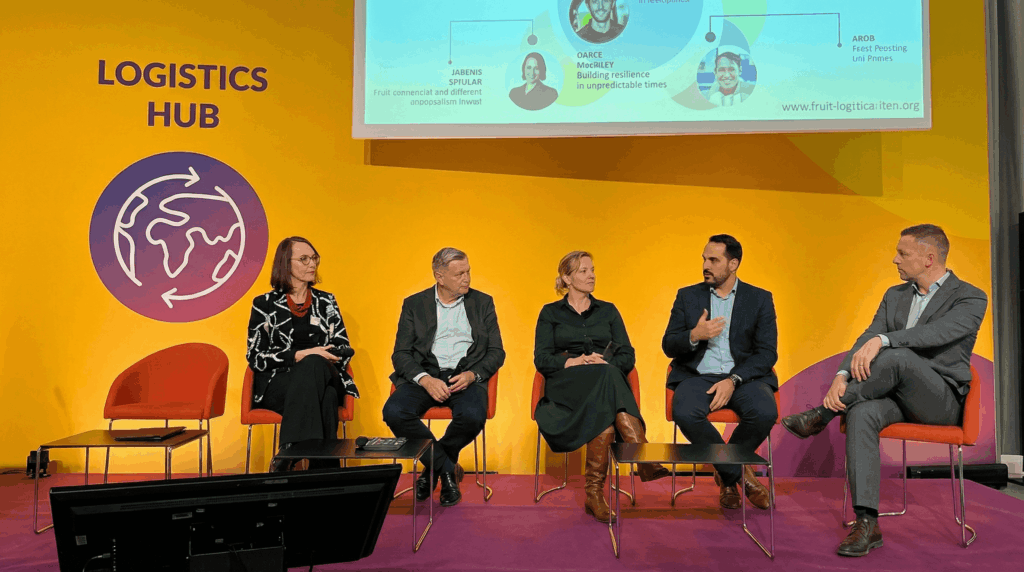
The Global Coalition of Fresh Produce recently convened at Fruit Logistica in Berlin to address the growing challenges facing the fresh produce industry.
The session, held at the Logistics Hub, was moderated by Steve Alaerts of Foodcareplus, who also chairs the Supply Chain Council at the International Fresh Produce Association (IFPA).
Participants examined the industry’s systemic volatility, focusing on how this affects shipping rates, capacity, and the integrity of perishable cargo.
The discussion highlighted the need for a resilient logistics model to navigate shifting trade flows, geopolitical shocks, and unpredictable regulatory environments.
Greg Palmer, vice president of trade and market development at the Canadian Produce Marketing Association, emphasized the importance of digital traceability and transparency for shippers worldwide.
- Global Coalition addresses fresh produce industry challenges at Fruit Logistica.
- Participants assess systemic volatility and its impact on perishable cargo.
- Importance of digital traceability and transparency highlighted for global shippers.
- Call for sustainable supply chains through clear pricing and contract terms.
- Emphasis on collaboration to create resilient logistics systems for produce.
Palmer identified three common disruptors in the supply chain: increasing transit delays, volatile import tariff structures, and rising cybercrime.
Werner van Rooyen, COO of the Fresh Produce Exporters’ Forum of South Africa, called for more transparency and predictability in logistics dealings.
Van Rooyen stressed that clear pricing, contract terms, and service conditions are crucial for sustainable supply chains.
He also advocated for prioritizing fresh produce over non-perishable items in shipping and customs procedures due to their high perishability.
Tineke van de Voorde from the Port of Antwerp–Bruges highlighted the role of port authorities as connectors in the supply chain.
Van de Voorde urged cooperation across the chain to tackle issues like port congestion.
Dirk Hoffmann of DP World Atlas warned of the urgent need to address climate change impacts on logistics.
Hoffmann pointed to innovative solutions like the new DP World Atlas service that connects Morocco with Belgium and the UK as steps toward reducing the logistics footprint.
Alexis Taylor, chief global policy officer at the IFPA, concluded the session by emphasizing the role of industry organizations in developing common good practices to enhance supply chain resilience.
Steve Alaerts wrapped up the session by calling for a foundational framework that promotes collaboration, transparency, and fairness throughout logistics chains.
This framework would serve as a common understanding and language to align actions with the shared goal of efficient logistics that deliver high-quality produce from growers to consumers.
Alaerts invited stakeholders to jointly formulate a set of values to transform global supply chains.
The session underscored the critical need for industry-wide collaboration to overcome current challenges and achieve resilient logistics systems.